

BY- APARAJITA SINGH

Unwittingly, the new age of social distancing has spawned a massive global experiment in mass remote working. While the workers’ job patterns have changed as a result of the restructured working policy, the challenges have remained the same. One of the most significant obstacles is workplace sexual harassment, which appears to be an issue for working women.
The Sexual Harassment of Women at Workplace (Prevention, Prohibition, and Redressal) Act, 2013 (“POSH Act”) currently governs sexual harassment in the workplace.
As a result, this article focuses on the question of whether the POSH Act effectively regulates sexual harassment in remote working or whether additional legislation is needed to protect women who work from home.
There has been a paradigm change from what was once considered a workplace since the Corona virus lockdown began. In the past, a workplace was described as an office or a business. Along with the Corona virus quarantine has came a government directive encouraging workers to work from home, and as time went by, work from home became the norm for the vast majority of people, firms, Industries.This paradigmatic shift resulting in working from home departs from the traditional meaning of workplace and, home is simultaneously accorded the status of a workplace. These developments raise pertinent questions such as:
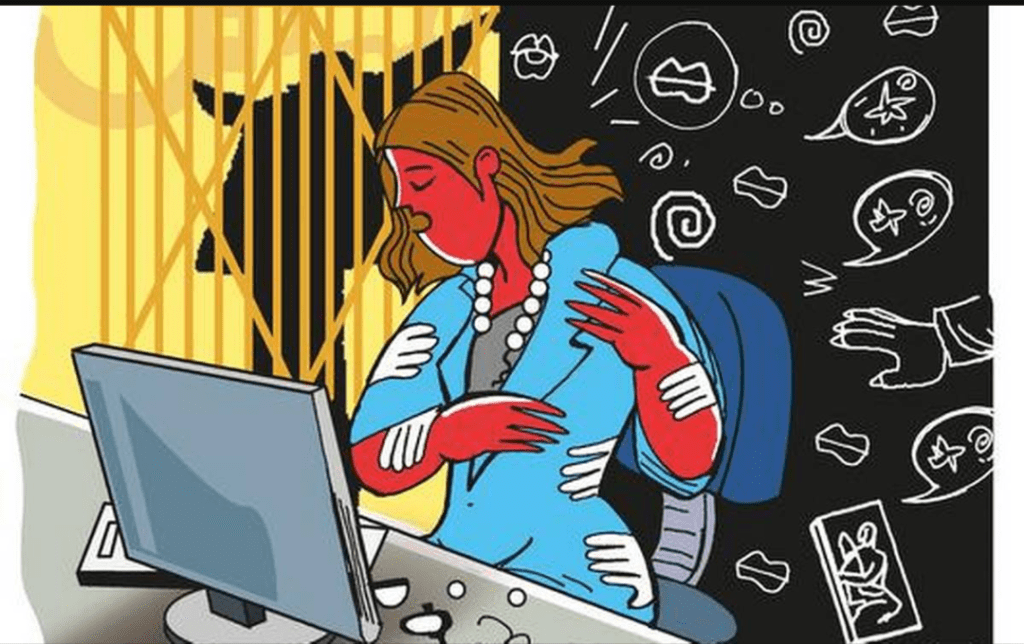
1) Is the Prevention of Sexual Harassment at Workplace Act still applicable when sexual harassment occurs while working from home via online medium?
2) What types of non-physical sexual assault are covered by the Act?
3) What legal options are available to victims of online sexual abuse when the courts are partly closed due to the Corona virus lockdown?
THE POSH ACT, 2013 RECOGNISES WORK FROM HOME:
The response to this question can be found in Sections 2 and 3 of the Sexual Harassment of Women at Workplace Act of 2013, which describes sexual harassment. Section 2(n) sub clauses (ii), (iii), (iv), and (v) deal with unwelcome actions or behaviour that may occur when working in remote locations, such as:
(1) Demand or request sexual favours.
(2) Making sexually coloured remarks.
(3) Displaying pornographic material.
(4) Any other unwelcome physical, verbal or non-verbal conduct of sexual nature.
Section 2(o) of the Act describes “workplace” in an inclusive and non-exhaustive manner, which includes “a dwelling place or a home” under sub clause (vi). The spirit of the Act, on the other hand, applies to domestic servants and helpers who are working in a dwelling place or a house as it means that the workplace requires a dwelling place or a house. Section 3 broadens the definition of sexual harassment by stating that all of the following situations, which are relevant to sexual harassment, can also constitute sexual harassment: implied or explicit “
(1) Guarantee of preferential treatment in the victim’s employment.
(2) Threat of adverse treatment in the victim’s employment.
(3) Threat regarding current or potential employment status.
(4)Humiliating treatment likely to endanger the victim’s health or safety when interfering with work or creating an intimidating, aggressive, or hostile work environment.”
Nonetheless, in the unprecedented extraordinary times of Coronavirus lockdown, the definition of workplace shall include work from home under Section 2(o) if the literal rule of interpretation is applied (vi). As a result, sexual harassment that occurs online when operating from home comes under the Prevention of Sexual Harassment at Work place Act 2013.
The Act recognises the following types of non-physical sexual harassment :
The response to this question can be found in Sections 2 and 3 of the Sexual Harassment of Women at Workplace Act of 2013, which describes sexual harassment.
Section 2(n) sub clauses (ii), (iii), (iv), and (v) deal with unwelcome actions or behaviour that may occur when working in remote locations, such as
(1) Demand or request sexual favours
(2) Making sexually coloured remarks
(3) Displaying pornographic material
(4) any other unwelcome physical, verbal or non-verbal conduct of sexual nature.”
Section 3 broadens the definition of sexual harassment by stating that all of the following situations, which are relevant to sexual harassment, can also constitute sexual harassment: implied or explicit
(1) Guarantee of preferential treatment in victim’s employment
(2) Threat of adverse treatment in victim’s employment
(3) Threat regarding current or potential employment status.
(4) Interference with work or creating an intimidating or offensive or hostile work environment
(5) Humiliating treatment likely to affect victim’s health or safety.

As a result, this broad description encompasses a number of issues that women face when working from home, including: sending personal and inappropriate messages, Jokes/forwards/videos/drawings/picture that are sexual in nature.
Over the phone or through video conferencing, sexual descriptions are given. On the phone, there is a lot of idle talk that is pornographic. During a conversation, unwelcome comments are produced. Stalking on the internet (in all types of social media) is a type of digital stalking. By posing inappropriate questions; you are invading someone’s personal space. Making sexual remarks about one’s weight, body shape, height, or figure. As a result, in response to the question posed, it can be inferred that the act itself contains examples of sexual assault that can be encountered when working from home online.
The Redressal Mechanism:
1) As a result, these are the types of sexual assault that are protected by the Prevention of Sexual Harassment at Workplace Act, 2013, and that one can experience when working from home online.
2) Within seven days of receiving the complaint, the respondent will be served with a note.
3).The investigation required by Chapter V of the Act must be completed in ninety days.
4).Within ten days, the investigation report will be forwarded to the employer or district officer.
5).The district officer or the employer must completely execute the directives within sixty days.
The Remedies:
Interim relief or compensation are available under the Prevention of Sexual Harassment at Workplace Act, 2013.
Interim Assistance:
The Internal Complaints Committee and the Local Complaints Committee will provide temporary relief while the investigation is ongoing, according to Section 12 of the Act. Interim relief may take the form of, for example:
a) The move of the aggrieved woman or the respondent to a different job.
b) Granting the aggrieved woman leave for up to three months, or
c) Any other relief deemed appropriate by the committee.
In the case of working from home, however,
In the case of work from home, however, the committee will provide temporary relief in the following ways:
(a).The aggressor or the aggrieved woman being transferred to a separate team or project where the essence of the job does not require all parties to communicate.
(b). Any other orders prohibiting the aggressor from contacting the aggrieved woman.

Compensation:
After the claims have been proven by, Section 13 allows the committee to grant compensation.
1).Deducting the respondent’s salary,
2).Ordering the respondent to pay compensation and if the respondent fails to pay the compensation, the committee will issue an order to the concerned District Officer for the recovery of the amount as an arrear of land revenue.
Under the Prevention of Sexual Harassment at Workplace Act, 2013, these are the solutions and recourse mechanisms that can be promoted and implemented through the internet. Online reports can be sent to the Internal Complaints Committee and the Local Complaints Committee.
The Internal Complaints Committee and the Local Complaints Committee will provide temporary relief while the investigation is ongoing, according to Section 12 of the Act. Interim relief may take the form of, for example.
a). the move of the aggrieved woman or the respondent to a different job.
b). Granting the aggrieved woman leave for up to three months.
c). any other relief deemed appropriate by the committee.
Conclusion:
Employees have a fundamental right to a protected workplace, and sexual harassment is a serious breach of that right. As a result, employers and companies bear the primary responsibility for eliminating all types of sexual abuse in the workplace. The POSH Act is effective in ensuring a healthy and stable work atmosphere for women in both physical and virtual environments. Assuming that If the above guidelines are followed, it will result in a successful implementation of this Act, which would go a long way toward protecting women’s rights at the workplace.
Download Your E-Article/E-Paper here!!
The Audiobook is only available for a week. Make sure you download it from the online link. (If you forget to download Your Audiobook don’t worry just reach out to us via [whatsapp] we will help you with the same.)


 The Independent Pioneer