BY- JASMINE MARWAH

• What is Artificial Intelligence?
Artificial Intelligence (AI) is commonly known for its ability to have machines perform tasks that are associated with the human mind – like problem solving.
But very less people know that it is also used in healthcare.
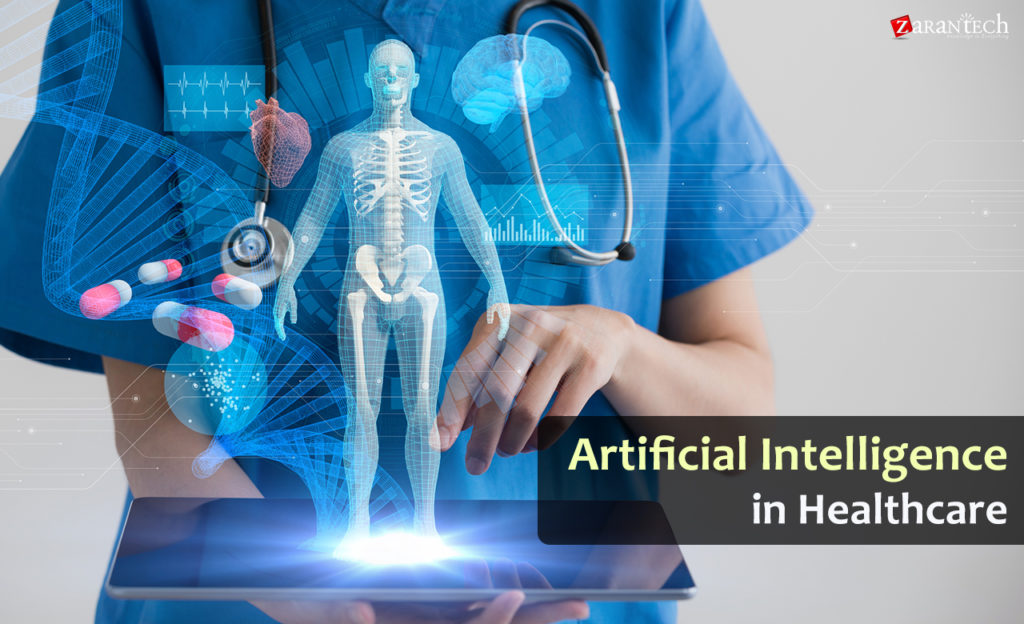
• What is Artificial Intelligence in Healthcare?
Well gone are those days when medical education was just associated with textbooks, AI has the potential to provide data-driven clinical decision support (CDS) to physicians and hospital staff – paving the way for an increased revenue potential. Also we need something that could challenge the doctors. So that physicians could understand that we don’t need lab reports for decision making instead we need brain.
Deep learning, a subset of AI designed to identify patterns, using algorithms and help us to leverage data and data given clinical decisions.
• AI in Health care
1. Biomedical research
According to the California Biomedical Research Association, it takes an average of 12 years for a drug to travel from the research lab to the patient. Only five in 5,000 of the drugs begin preclinical testing and ever make it to human testing and just one of these five is ever approved for human usage. Furthermore, Path from research lab to patient is very costly too.
This was a problem until,
Drug research and discovery is one of the more recent applications for AI in healthcare. Because of AI now there is convenient assistance in automated experiments ,automated data collection, gene function annotation( A process of identifying functional elements along a sequence of genome) , literature mining(the process of applying data mining techniques to databases of published literature.)
Plus, there is a significant decrease in the cost of the drugs.
2. Translational research-
Translational Research delivers original investigations in the broad fields of laboratory, clinical, and public health research. This term is mostly used in biotechnology and life sciences. It provides assistance in biomarker discovery(biomarker is a molecule that allows the detection and isolation of a particular cell type (for example, the protein Oct-4 is used as a biomarker to identify embryonic stem cells ), drug target prioritization(The drug target prioritization is evaluated by checking the rank of known drug targets (obtained from STITCH) in the sorted list of all proteins.), genetic variant annotation.
3. Medical training-
The advent of natural speech and the ability of an AI computer to draw instantly on a large database of scenarios, means the response to questions, decisions or advice from an AI can challenge in a way that a human cannot. As I already explained,
It can challenge decisions made by a physician and also help trainees in making clinical decisions.
And training can be done anywhere; with the power of AI embedded on a smartphone, quick catch up sessions, after a tricky case in a clinic or while travelling.
• AI in Pharmacy
1. Development of new drugs-
As already explained in biomedical research, pharma businesses are using AI to increase the success rates of new drugs while decreasing operational costs at the same time. Verge genomics is currently working on this.
Verge Genomics uses AI to predict the effect of new treatments for patients suffering from ALS & Alzheimer’s.
2. Tackle previously difficult diseases-
Traditionally, pharmaceutical companies don’t focus their efforts on treatments for rare diseases because the return on investment doesn’t warrant the time and cost it takes to produce the drugs.
AI in pharmacology can also be used to find cures for known diseases such as Parkinson’s and Alzheimer’s, as well as rare diseases. This is great news considering the fact that 95% of rare diseases do not have a single FDA approved treatment, according to Global Genes. Currently healx is working on this.
Healx uses AI to help biotech companies find treatments for rare diseases.
3. Clinical trials-
Cognizant study showed that around 80% of clinical trials fail to meet enrollment timelines, and one-third of all Phase III clinical study terminations are due to enrollment difficulties. Extracting and making sense of clinical data from medical records is highly sought-after in the medical and pharma industries and AI can be the answer to it. Currently,
Deep 6 uses AI to proactively find drug trial candidates .
And now the most awaited question
Will AI replace human health care professionals?
According to a survey, more than 70% of Americans fears, robots taking over their lives.
More than 33% of people are enthusiastic about the future of robots.
And it is absolutely true , experts are very confident that AI will operate hand in hand with humans in their workplace, and not take their jobs.
1.AI can never show empathy towards ailing .
- Treating a patient is not linear process, it takes a diverse conversation and delving into all possible reasoning to a particular symptom to find the actual problem.
- AI will need to be competent like actual Health care professionals.
- There are limitations to what AI can do.
- It was never a battle between AI and humans . It is a tool which can be really useful. Creativity , ingenuity and human nature are all things that machine cannot replicate.
What do health care students actually need to know about artificial intelligence?
- Students need sufficient practice, knowledge and experience required for taking ultimate responsibility for their patients while applying AI tools on them.
- They should acquire the basic knowledge which constitutes the fundamentals of how to use AI for medicine.
- Don’t try to dig so much knowledge about AI in medicine on media and internet. Rather than try to develop abilities to distinguish correct information from hype and spin.
• Current development of health care industry in AI.
- Top 20 Start-ups in India revolutionizing Health-Care Industry with Artificial Intelligence.
• Qure.ai
• Tricog
• Sigtuple
• Nirmai Health Analytix
• PharmEasy - According to nature index 2020 artificial intelligence, India has been the third most productive country in AI research, with over 23,000 papers.
How artificial intelligence has helped in covid-19 situation?
1. It has enabled organizations to scale and adjust
Machine learning technology is playing an important role in enabling that shift by providing the tools to support remote communication, enable telemedicine, and protect food security.
One example is Clevy.io, a French start-up and AWS customer, which has launched a chatbot to make it easier for people to find official government communications about COVID-19.
Agri-tech start-up Mantle Labs, another AWS customer, is offering its cutting-edge AI-driven crop-monitoring solution to retailers free of charge for a period of three months to provide additional resiliency and certainty to supply chains in the UK.
2. Understanding how COVID-19 spreads
Machine learning is also helping researchers and practitioners analyze large volumes of data to forecast the spread of COVID-19, in order to act as an early warning system for future pandemics and to identify vulnerable populations. Researchers at the Chan Zuckerberg Biohub in California have built a model to estimate the number of COVID-19 infections that go undetected and the consequences for public health, analyzing 12 regions across the globe.
BlueDot, a Canadian start-up and AWS customer that uses AI to detect disease outbreaks, was one of the first to raise the alarm about a worrisome outbreak of a respiratory illness in Wuhan, China. BlueDot uses AI to detect disease outbreaks.
3. Speeding up research and treatment
Healthcare providers and researchers are faced with an exponentially increasing volume of information about COVID-19, which makes it difficult to derive insights that can inform treatment.
In response, AWS launched CORD-19 Search, a new search website powered by machine learning, that can help researchers quickly and easily search for research papers and documents
Machine learning can also help accelerate the discovery of drugs to help treat COVID-19. BenevolentAI, a UK AI company and AWS customer, turned its platform toward understanding the body’s response to the coronavirus. They launched an investigation using their AI drug discovery platform to identify approved drugs which could potentially inhibit the progression of the novel coronavirus.
In India,
DRDO develops artificial intelligence algorithm to detect Covid-19 presence from chest X-rays
“It can be a very useful tool especially in smaller towns in our country owing to lack of easy access to CT scans.”
Dr U K Singh, Director, CAIR
The Defense Research and Development Organization is the premier agency under the Department of Defense Research and Development in Ministry of Defense of the Government of India, charged with the military’s research and development, headquartered in Delhi, India.
In a development expected to help diagnose Covid-19 in suspected patients faster, the Defense Research and Development Organization (DRDO) and Centre for Artificial Intelligence and Robotics (CAIR) have created an artificial intelligence (AI) algorithm to help detect Covid-19 from chest X-rays.
According to its developers, the tool named Atman AI, used for Chest X-ray screening has shown an accuracy rate of 96.73 per cent. Dr U K Singh, Director, CAIR, DRDO said the development of the diagnostic tool was part of DRDO’s effort to help clinicians and partners on the frontline to help rapidly diagnose and effectively treat COVID-19 patients.
It is my hope that in this difficult time we can work together on a global scale to innovate and find new ways machine learning can contribute in the fight against COVID-19.
Download Your E-Article/E-Paper here!!
The Audiobook is only available for a week. Make sure you download it from the online link. (If you forget to download Your Audiobook don’t worry just reach out to us via [whatsapp] we will help you with the same.)

 The Independent Pioneer