

BY- ANJANA VIJAY

NAARI FOUNDATION
B.A LL.B Honours Criminal Law (Student)
UPES, Dehradun
Sometimes we can learn something from those we disrespect in ignorance. I say so because I remember studying a novel named Sangati pertaining to the category of Dalit literature in which a special kuchulu (a kachcha temporary hut) is made for a girl who “comes of age” for the first time. Belonging to a poor family, being the eldest among the three children of a mother (who died while giving birth to her) and a drunk indifferent father, she could not afford a proper diet needed during those days. But the story showed that a community that only drank rice water everyday for their meals took turns to cook something healthier for the girl and feed her considering she needed rest and nutrition as she was in pain and bleeding. But, on the contrary, I find the so-called Upper castes (both the gender) or ‘educated’ or ‘rich’ people segregating, isolating, scolding, staring and traumatizing girls or women in periods. They are either unaware or indifferent or unempathetic to the bleeding girls and women of their homes.
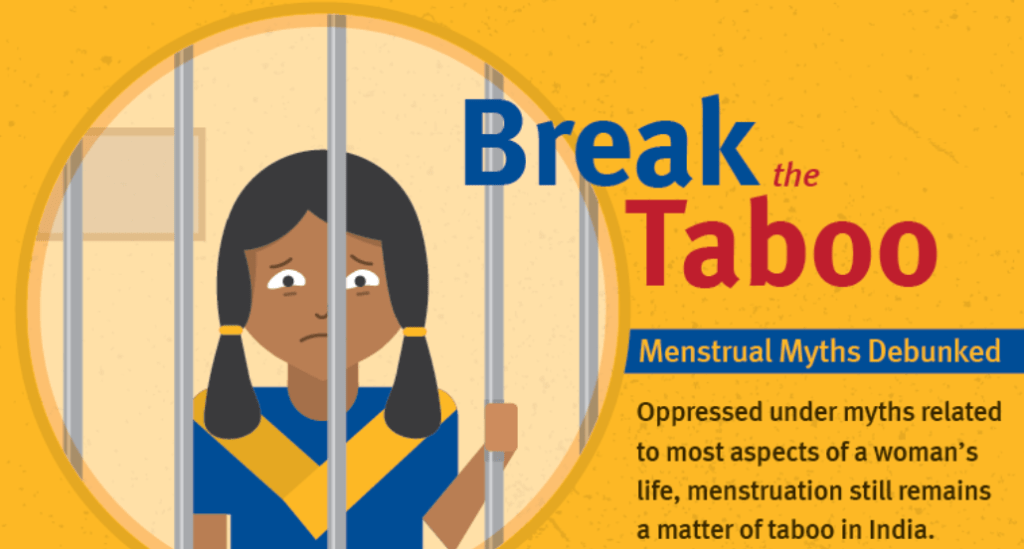
Menstruation is one very important aspect of womanhood. Men cannot give birth so they don’t bleed every month for several days. Men cannot carry a child in womb for nine months and thus women bleed profusely after giving birth. Men can only impregnate them but a woman turns a couple to a family. Then why discriminate, be indifferent, laugh, stare, show disgust to those who are actually the ones to be venerated, even according to Vedas? Why make them feel guilty or at fault for something that’s natural and is not a woman’s choice but a blessing in disguise for humanity? Statements like ‘don’t touch the vessel of milk or else it will curdle’, ‘don’t go the temple or even near it’, ‘don’t sit on the bed or chair that everyone uses’, ‘you are such an expenditure’, ‘you have spots, learn some manners’, ‘don’t put mehndi during those days and go out as the spirits are always on the look out for such strong smells’ (seriously? They don’t have anything else to crave for?) etc. make women wonder whether menstruation is a good sign of fertility or an incident of abhorrence.
There have also been so many weird practices around menstruation in the world that enforce a woman to think at least once in a lifetime that why did she take birth as a woman at all. I would also like to bring in the reference to the short film Maya (2001) directed by Digvijay Singh. Maya’s happy idyllic life changes overnight when she reaches her puberty. Thereafter, she is prohibited from playing, talking aloud, starts doing household chores and her first cycle is announced in front of the whole village to prepare for a celebration of the same. Before Maya could understand what is happening to and with her, she is taken to a renowned temple for a religious ritual in which the girl is taken inside the temple by a line of priests to pray for her well being and bless her. She is heard outside by the family shouting terribly till she comes out limping and shaking because of the horrifying ritual rape she is subjected to in the name of religious and social practices.
There are many ways that menstrual issues are handled or discussed in the world, both supportive and harassing. What this article expects from the readers is to just think of each other as humans; men and women both feel pain, so both need to be taken care of, to be treated empathetically and to be looked at as equal creations of God. The world needs to accept that if adjusting the crotch in a public place (to handle uneasiness) is okay for men, adjusting a pad (to avoid stains) should be okay for women.
Download Your E-Article/E-Paper here!!


 The Independent Pioneer